DR. REET KAMAL TIWARI
Associate Professor
Indian Institute of Technology Ropar
Guha, S., Tiwari, R. K., & Zhang, G. (2024). A Multifaceted Look at Garhwal Himalayan Glaciers: Quantifying Area Change, Retreat, and Mass Balance, and Its Controlling Parameters. Environment, Development and Sustainability, 1-24
A Multifaceted Look at Garhwal Himalayan Glaciers: Quantifying Area Change, Retreat, and Mass Balance, and Its Controlling Parameters
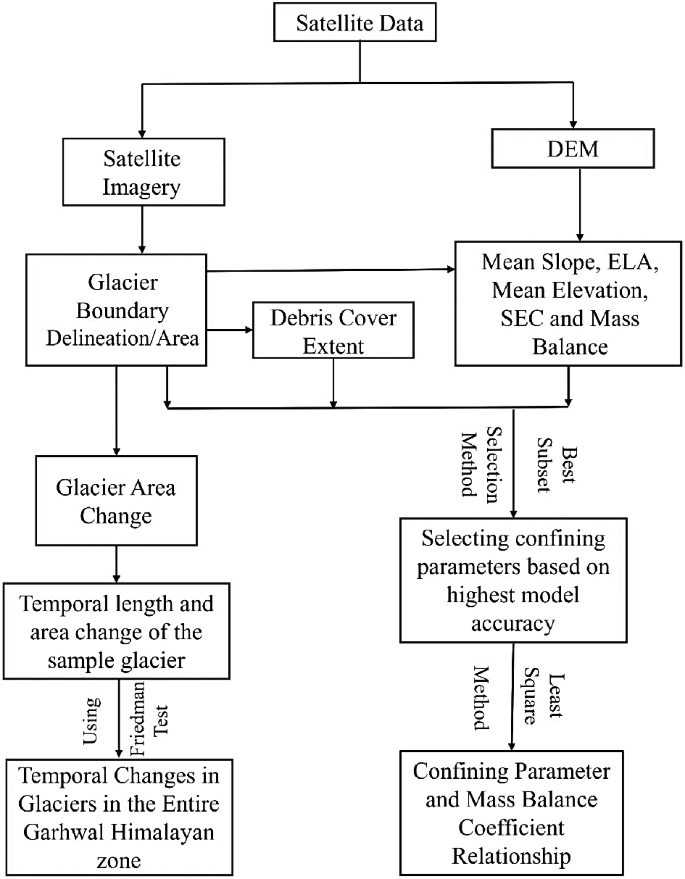
Assessing glaciers’ response to climate change is vital for water resource management. This study investigates changes in glacier areas, retreats and mass balance in the Garhwal Himalayan region. Initially, multitemporal Landsat imagery was used to delineate sample glacier boundaries for different study years manually. Subsequently, the Friedman test was employed to assess glacier area changes and retreats’ temporal status across the Garhwal Himalayan region. The findings reveal a 1.12% deglaciation rate, consistent across observation periods. Mean area change for the first (2001-11), second (2011-16), and third epochs (2016-21) range from − 0.053 to -0.203, -0.084 to -0.309, and − 0.088 to -0.257%yr− 1, respectively. Glacier retreat also shows homogeneous length loss across all epochs, with mean scores ranging from 7.024 to 14.65, 7.87 to 17.03, and 8.956 to 14.98 myr− 1, respectively. Mass balance ranges from − 0.547 to -1.089 m.w.e.yr− 1 between 2000 and 2020, influenced by variations in mean slope and debris cover on individual glaciers. Debris cover and glacier slope are identified as key determinants, with debris cover exhibiting a positive coefficient and glacier slope demonstrating an inverse relationship with mass balance. Additionally, a 10% increase in debris cover corresponds to a 0.36 m.w.e.yr− 1 mass gain for a given slope, while a 10% increase in slope steepness results in a 0.86 m.w.e.yr− 1 mass loss for a given debris cover. The study highlights that glacier area doesn’t affect the heterogeneous response. Instead, a strong correlation exists between glacier area and debris cover, with debris cover playing a key role in characterizing responses to changing climates. Thus, glacier area serves effectively as a proxy for debris cover extent.
Gallery


